Classic Finns
Introduction:
This is a brief coverage of Finn development intended to be a starting resource for owners of older Finns in the UK and those considering ownership. Much fuller histories and technical articles are available, some of which are referenced in the Further Reading section. The opinions are personal views of the author. Although the Finn at its current level of development is an expensive highly developed piece of kit, the hulls are very strongly built and as a result last for very many years. The continual updating of rigs at the top level means it is possible to buy a very old hull and update the rig fairly cheaply to achieve a good club racer. The Finn is generally sailed by heavyweights, but since it rewards good techniques almost more than any other single-hander its also hugely satisfying to sail for lighter helms, and since I started sailing Finns at the age of 16 and weighing 10 ½ stone I’ve never really considered then to be exclusively for heavier guys.
History:
The Finn was first designed in 1949 by a Swede, Rickard Sarby in response to a design competition for the Olympic single hander. In previous Olympics the single-handed dinghy had been selected by the host nation and sailors found they had to get used to a new dinghy for each Olympics (in 1948 at Torquay it was the Firefly). The Finn came last in the competition but won all the sailing trials! Because it could be built by anyone and required a high level of skill to sail it became very popular and remains the Olympic single hander today. However continual development has meant significant changes in technology and ensured the Finn remains up to date. From 1949 to 1960 all hulls were wooden, either cold moulded as the original, strip planked or hot moulded by Fairey Marine. Development of the wooden mast to change the bend characteristics and sail development to match was the main theme. The class was dominated by Paul Elvestrom, a Dane, who carried out much of the development himself and won the Olympics in the Finn in 1952, 1956 and 1960. Fibreglass was first allowed for the hull in 1961, leading to its dominance for several years which many thought was a bad development, until Raudaschl won the Gold Cup with a home built wooden boat in 1964. Masts continued to be built of wood with Georges Bruder of Brazil leading development. In 1972 the class changed with the introduction of Needlespar masts at the Olympics in Germany. Initially the 3B was a stiff brute, with an oval bottom section and tapered sleeved top section. This was followed very quickly by the 3M with a round bottom section and this remained the standard rig right up until the introduction of carbon fibre. In the late 70s North sails began their virtual domination of the class which continues to this day. Some good wooden hulls were still being built, notably by Peter Taylor in Salcombe and then in the mid 70s he started making glass fibre, double bottomed boats which dominated for some years. Meanwhile in Canada Vanguard boats were building good Finns and by careful exploitation of the hull shape tolerances, good weight distribution and a good combination of stiffness and flexibility they began a very long domination of the class from the late 1970s right up to 1993. The Vanguard Finns also lasted very well and are still a very good club racer.The new era started in 1993 with the introduction of carbon masts and plastic (Mylar) sails in 1998. The rules were changed to allow the mast to be moved forward at the deck to suit the new rig’s characteristics and really good boats were built in the UK again, by Tim Tavinor of Devoti Boats at Burnham on Crouch. (Devoti boats are still built now but in Eastern Europe.) In recent years other builders have also been successful. In summary Finns neatly divide into three eras. Many of the Vanguard Finns have been updated with carbon masts, plastic sails and adjustable deck rings so Vanguards can be considered to be the current era, along with Devotis, Lemieux, Pata and such like, all with carbon/plastic rigs. Current tuning and sailing guides are applicable to these boats.The ‘classic’ era (using the term loosely) is for those boats built before Vanguard’s domination and carrying a Needlespar/Dacron rig. In the UK these are boats built by Taylor along with earlier boats updated with a Needlespar rig. The setting up, tuning and sailing of such boats is covered very well by the British Finn Association produced Finn Sailing Manual. This is written for the 80s standard Vanguard / Needlespar 3M / North combination.The ‘vintage’ era are those boats with original wooden masts. Not many wooden masts have survived, as popular modifications included planing them down or gluing extra wood on to get the right bend characteristics and breakages were very common.
Mast Basics:
The basic maxim is that a heavy guy needs a stiff mast and a lighter guy a softer mast. However the combination of sideways and fore and aft bend has occupied whole careers! In addition it’s very important that the sail matches the mast bend so it’s normal to buy them together, whether new or second-hand. Collar wooden masts, made at Oxford, were the basic club level Finn masts, rather stiff and heavy. Bruder masts from Brazil were the very best wooden masts, winner of the Gold Cup many times. Boyce wooden masts were very successful in the last days before aluminium came in. After 1972 John Boyce at Burnham-on-Crouch also made aluminium masts, using an oval tube, cut and welded at the top to produce the taper. Very successful in the OK class they were never very common in Finns. Needlespar masts were boldly selected for the Olympic games in 1972 to reduce the variability of the wooden masts supplied to the competitors. (All Finns are supplied for the Olympics by the host country). The early masts were oval tubes at the bottom with a series of reducing diameter tubes for the top mast, glued together and turned down on the outside to provide a smooth taper. Later the bottom section was also round, but with thicker walls at the side than fore and aft. Different bend characteristics could be achieved with shorter or longer top masts, to produce stiffer or softer masts as required. The bend characteristics can therefore be guessed at by measuring the height of the top mast join. Needlespar also produced a few softer Delta masts with a D section bottom tube. These were standard for the Lightening 368 class.Mast bend characteristics are usually defined by supporting the mast at the base ring and deck ring then hanging a fixed weight from the top. Bend is then measured at the top, half and quarter heights. Both sideways bend and fore and aft can be measured in this way.In the days of wooden masts it was generally accepted that mast bend could be selected to suit a wide range of helm weights. However, masts varied a lot and so much adjusting and swapping of masts took place to get a fast mast. Aluminium masts introduced much greater reliability and mast selection became much less of an issue. However alloy masts were generally much stiffer and so lighter helms (less than 15 stone) became less competitive. A claimed advantage of carbon masts is that it has re-introduced the possibility of softer masts for lighter helms.
Hulls:
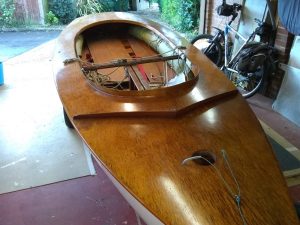
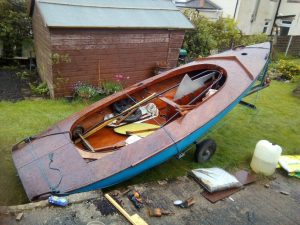
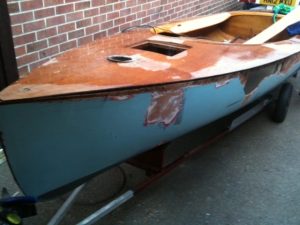
Fairey Marine started producing Finns in about 1955 and produced over 100 until production ceased in 1963/4. They were usually built of three diagonal layers of birch veneers and baked in an oven to set the glue. The hulls were very resistant to rotting and so quite a few survive. Fairey also made rolled side tanks by the same process but also many bare hulls were sold to other builders or amateurs so there are some variations in deck and tank arrangements. Some of these others have buoyancy bags, others built in tanks. Also some hulls were finished and registered long after Fairey ceased production.
Elvstrom Finns were among the first glass-fibre Finns and quite a few were imported into the UK in the 60s. They were originally very competitive and remained successful at club level well into the 70s.
Pearson were the ‘bread and butter’ builder of glass fibre club level Finns from 1962 until they stopped building Finns, with their last being about 19 73. Never really considered by the Olympic aspirants they never the less were a reliable and popular club racing dinghy. Most had built in side tanks with a few variations in deck and tank arrangements over the years. During the late 60s and early 70s a fleet of Pearson Finns were used by Dunhill for the popular Finn Finder events, aiming to recognise emerging talent from club racers.
Tiptree Marine in Tiptree, Essex built several glass fibre Finns between 1967 and 1969 alongside Flying Dutchman. They had small side tanks built in and were probably never as good as the Pearson Finns, mainly due to being too heavy in the bows resulting in a lot of pitching in chop. They only sold to club sailors.
Butler built a few Finns in 1967 and 1968 but never in large numbers. They were similar to the Pearson Finns but probably slightly more competitive, again at club level.
Peter Taylor at Salcombe produced very good wooden Finns and was the first to produce a double bottomed Finn in 1972. Taylor glass fibre Finns were very successful, dominating the 1976 Gold Cup and world competition accounting for almost all Finns registered in Britain from 1979 until 1993.
In East Germany Mader made wooden Finns for many years but by supplying the glass fibre Finns for the 1972 Olympics became quite popular for a while, with several being imported to the UK.
Vanguard Finns were produced by the Harken brothers, initially with wooden floors and then with double bottoms. Several designs were produced, all more successful than the previous but the boundaries were blurred by conversion kits to update earlier boats. Many Vanguard Finns were imported to the UK since they were the dominant builder for many years. Vanguards also seem to have also started the trend for Finns to be re-registered in several different countries as they changed hands.
In 1993 Devoti Finns ended the domination of Vanguard and took over until very recently when again, for the first time in very many years competitive Finns are available from a number of builders. In addition to these boats in the UK several Finns were built by well known dinghy builders and through the years small numbers of boats have been imported from well known builders world wide.
Controls:
Sails:
The matching of a sail’s luff curve to the mast bend characteristics has always been a Finn art from the earliest days when Elvstrom realised its importance. This makes sail selection for the classic Finn owner a bit of a problem because of course no-one still makes sails for alloy masts, let alone wooden ones. My own opinion, without prejudice, is that a new sail is probably better than a well used one even if in theory its’ luff curve doesn’t match the mast. I know a 70s Mader Finn that sets a 2004 North Mylar sail on a Needlespar 3M and sails significantly faster than it did with an old sail designed for the mast. There are a few unused Dacron sails from the 80s still about, whether they’d be faster on a Needlespar mast than a good modern plastic sail I really wouldn’t like to say.In the late 60s and early 70s many club sailors used Seahorse or Banks sails on a Collar mast, with Musto sails becoming popular, often with a Boyce wooden mast. With the introduction of alloy Needlespar masts Musto initially were the common sailmaker but from the mid 70s onwards North became dominant. Musto continued Finn sail development however right up to the present day and have always produced fast sails alongside North. No other sail maker in the UK has invested as much in development as these two sailmakers so with the odd exception (say Sobstad for early plastic sails) no other sailmakers have managed to produce significant numbers of fast Finn sails.The classic Finn sailor with a Needlespar mast therefore needs to look for a good condition Dacron sail ideally from North or Musto. A good plastic sail on a Needlespar seems to work reasonably well although probably less in the spirit of a classic (whatever that means). For a wooden mast the options are much less clear. An original sail, even if perfectly matched to the mast when made, is likely to be in pretty poor condition and a later sail is very unlikely to set well on a wooden mast. My view is that a wooden mast can be used for vintage (CVRDA) events provided the handicapper gives you an allowance, but for club racing only a Needlespar with a good condition North or Musto sail is worthwhile.
Handicaps:
A classic or vintage Finn is never going to be competitive with a current era Finn. However a classic Finn well sorted is quite capable of being sailed into the top half of a modern handicap fleet on the current PY number of 1069. My guess for a more accurate PY for a classic Finn would be about 1075 (i.e. fractionally faster than a new Laser).For a Finn sailing with a wooden mast I don’t think there’s any reliable guide other than to plead with the Race Officer for leniency!
Further Reading:
FINNatics published by the International Finn Association is now out of print but some chapters are available on the web site. In particular Technical Trends covers Finn development and includes good pictures of Elvestrom, Pearson and Mader Finns.
Finnlog is also now out of print. It was published in 1986 and largely updated in FINNatics.
Elvstrom, Paul Elvstrom Speaks on Yacht Racing. Much good stuff on Finn sailing.
Both the British Finn Association and the IFA web sites have technical information.The North American Finn website has an excellent guide to rigging, safety and sailing, most of which will be applicable to all Finns. Follow Photo Gallery, Jan Walker Regatta Photos, Finn Sailing